Unsuccessful Login With Service Please Try Again
Manage unsuccessful login attempts with account lockout policy
Larn how to create account lockout policies that detail how many unsuccessful login attempts are allowed before a password lockout in social club to prevent credential-based attacks.
Due to the oftentimes overwhelming prevalence of password authentication, many users forget their credentials, triggering an account lockout following likewise many failed login attempts. Upon beingness locked out of their business relationship, users are forced to validate their identity -- a process that, while designed to dissuade nefarious actors, is also troublesome for legitimate users.
"Account lockout is, from a user perspective, a jarring and in-your-confront experience," said Allan Foster, principal evangelist at ForgeRock.
But the experience is integral to mitigate risk, said Casey Ellis, CTO and founder of Bugcrowd.
"While inconvenient for legitimate users, it is not too inconvenient -- and it can deter attackers," Ellis said. "Information technology is a resilient and boxing-tested reset strategy that is highly bachelor for multiple utilize cases."
Why enterprises need account lockout policies
Business relationship lockout policies aim to preclude credential theft, credential stuffing and brute-force methods of guessing username and password combinations, thus preventing user account compromise and network intrusion.
This is an of import aspect of not only securing enterprise systems, just also securing users' personal accounts and data. Companies must determine confidently whether users trying to authenticate are actually who they say they are, or they take a chance falling victim to attack.
The default approach to this is to go far harder for potential attackers to compromise accounts. There are two main techniques used to exercise this, Foster said. Ane manner is to tedious down the authentication cycle by making users expect longer and longer every fourth dimension there is an unsuccessful login effort, he said.
The other technique is bibelot detection. "Account providers tin can close down the account when anomalous behavior is detected until they tin connect with the original owner to confirm their identity for authentication," Foster explained.
Account lockout policy features
The business relationship lockout policy is made upward of three cardinal security settings: business relationship lockout elapsing, business relationship lockout threshold and reset account lockout counter subsequently. These policy settings help prevent attackers from guessing users' passwords. In add-on, they subtract the likelihood of successful attacks on an organization's network.
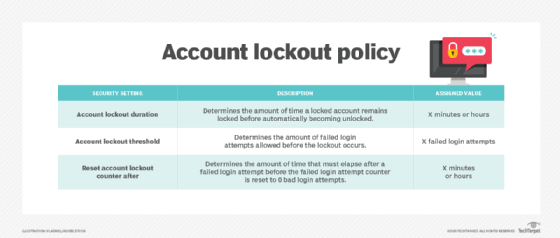
Enterprises should consider a combination of these three when building an account lockout policy.
Bugcrowd's Ellis recommended Apple's iPhone password lockout policy features. "If you forget or don't properly enter your password a certain number of times, y'all will exist unable to try logging back in to the device for a brusk time," he said. "Subsequent attempts extend the lockout catamenia. This tin can testify that either the individual entering the password is a forgetful user or an unauthorized private attempting to obtain illegitimate access."
How to create account lockout policies
Setting account lockout policies -- including lockout duration and thresholds -- is what Ellis chosen a "dark fine art."
At that place are many factors to consider when determining account lockout policy security setting values. But, because every enterprise is unlike, information technology is difficult to recommend standard values for the three security settings without calculating the organisation's risk profile kickoff. Policymakers should account for whatsoever regulatory requirements and adjust values accordingly. The capabilities of computing resources, every bit well as employee productivity, should besides be deemed for.
It is besides disquisitional to weigh exposure risks prepare by the security group, ForgeRock's Foster said. "Accounts with different capabilities have different levels of risk, both to the user and to the arrangement in the event of a compromise," he said. "Any business relationship where the impairment that tin be caused is high or is higher than normal requires a college level of protection."
If a privileged account shows any indication of assault, the immediate response should exist to presume information technology is an attack and to lock down the business relationship. Administrators may want to implement unique settings for privileged accounts, such every bit a longer account lockout duration and lower account lockout threshold.
While this seems similar a commonsense best practice, information technology'due south important to consider the dash of privileged accounts, Foster said. For instance, some privileged accounts may exist responsible for planning a response to a security effect. "Yous don't want the reaction to the threat to also compromise your power to respond to that threat," he added.
Analyzing these factors and hypotheticals is critical to successfully creating an account lockout policy that ensures security needs and UX needs are both met.
Limitations of business relationship lockout policies
An account lockout policy alone is not a cybersecurity silverish bullet. Enabling multifactor authentication (MFA) and single sign-on (SSO) are critical measures that should likewise be incorporated into enterprise identity and access management programs, said Anurag Kahol, CTO and co-founder of Bitglass.
"MFA confirms user identity and investigates suspicious logins, while SSO helps organizations directly manage access to sensitive information past blocking or providing various levels of access to data and applications based on user identity and context," Kahol said.
Managing identities and admission privileges has get even more demanding tasks as many organizations transition to remote work. Implementing the right policies and settings can empower administrators to manage and secure every account.
This was last published in September 2020
Dig Deeper on Identity and access management
-

Learn to adjust the AdminCount attribute in protected accounts

Past: Mike Kanakos
-

privileged access management (PAM)

Past: Sarah Lewis
-
![]()
Russia using Kubernetes cluster for beast-forcefulness attacks

By: Shaun Nichols
-
![]()
10 RDP security all-time practices to prevent cyberattacks

By: Michael Cobb


Source: https://www.techtarget.com/searchsecurity/answer/Account-lockout-policy-Addressing-too-many-failed-login-attempts
0 Response to "Unsuccessful Login With Service Please Try Again"
Post a Comment